Friday, 19 April 2013

youth Enviornment Service observes the national sanitatoin week and commemoration of the World water Day
Youth Environment Service supported by Uganda water and Sanitation Network (UWASNET) in partnership with Busia Municipal Council, and other stakeholders,operating in Busia District as World Vision Busia, Child Fund Busia and Red-Cross Busia Branch observed the National Sanitation Week which begun from 18th to 21st, and commemorated with the World Water day on the 22nd of March 2013. The activities conducted included; The world Toilet Cup game in three villages of Mawero East "B", Solo "A", Mugungu "A" ''Flag the poo" game in two villages of Mugungu "A" and Solo "A"; Sanitation debates in the following four schools (1) Victory, (2) Busia Border,(3) Busia Basic and (4) Parents' pride primary schools with a motion "Open defecation is a shame". Other activities included, cleaning 3 water sources and water collection equipments headed by the village environment committees (VECs), WASH United Girls' football competitions. The celebration of the World Water day drew stakeholders including the Chief Administrative Officer (CAO), the District chairperson, the Mayor, Water Officer, Environment Officer, Health Inspectors at the divisions, the 4 participating schools, NGOs representatives and the entire community.Over 1000 people where in attendance to observe the world water day occasion
The day started with cleaning of the selected well in Solo "A" called Omudik Spring well, and walking for water with band. The venue was in Solo "A" at chairman's palace where speeches from different guests were presented, school children presented sanitation songs and poems and they where awarded with sanitation improvement gifts to best performers and the launch of the World Toilet cup by the chief guest the Chairperson Busia District.
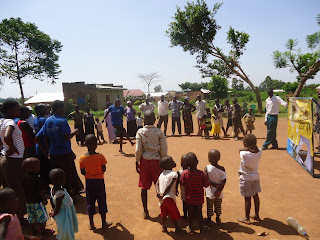 World Toilet cup game in Mugungu 'A'
 'I have always been kicking in the loo', I cant fail when everybody is watching. A village member bragging as he scored his poo in the loo during the World Toilet Cup game in the village- Mawero East B, Busia Municipal Council.

 Mr. Ssebowa a Sanitation Improvement Committee member of Solo A village was among the team who flagged the poo
 No water for you unless you clean your water container.During the Sanitation Week,women were mobilized to clean their water containers.
 General cleaning at the spring well and inspection of water collection equipmentts at Nanguke spring well in Mawero East B
 Make sure all that mud is scooped out. A SIC member instructing the community on water drainage
 I wish I could quit this job. How long will I continue doing this. One of the volunteers for 'flag the poo' game seemed to be saying
 What the hell!!. This smell is disgusting.

At least this one is smaller. She seemed to be murmuring.
 Cha- cha, cha-cha, A community member participating in cleaning their spring well, in names of Omudiki well
 People were using this bush for open defecation, but now we have cleaned it. Our well should improve, thanks to the YES people. Community members where heard, saying during the clean up of the well to commemorate the National sanitation week.

More snap-shot for the clean up exercise at Omudiki spring well during thee sanitation week
 School children marching during the World Water Day celebration in Busia
The matching teams arriving at the venue during the celebration of the World Water day
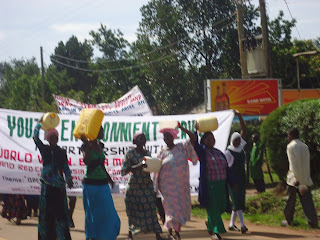
Sanitation Improvement Committee members with their Jericans walking for water during World Water day celebration.

A young boy caught in action-openly defecating during the 'flag the poo' activity.

Members of Solo A village after cleaning their spring well

 The Guest of Honour (Ag. District Chairperson- Busia) giving her speech during the World Water Day Celebrations.
 The Guest of Honour on behalf of Youth Environment Service awards gifts to the four school which participated in sanitation debate and celebration of World Water Day. The four schools were; Busia Border, Busia Victory, Busia Basic and Parents' Pride Primary schools.

"Mobilizing the communities to participate in household sanitation promotion"
(YES Photos) 
The ball is not going to enter, shame upon me. A community member from the Karamojong group seemed to be lamenting as her ball bounced in a wrong direction.
 'I have always been kicking in the loo', I cant fail when everybody is watching. A village member bragging as he scored his poo in the loo during the World Toilet Cup game in the village- Mawero East B, Busia Municipal Council.
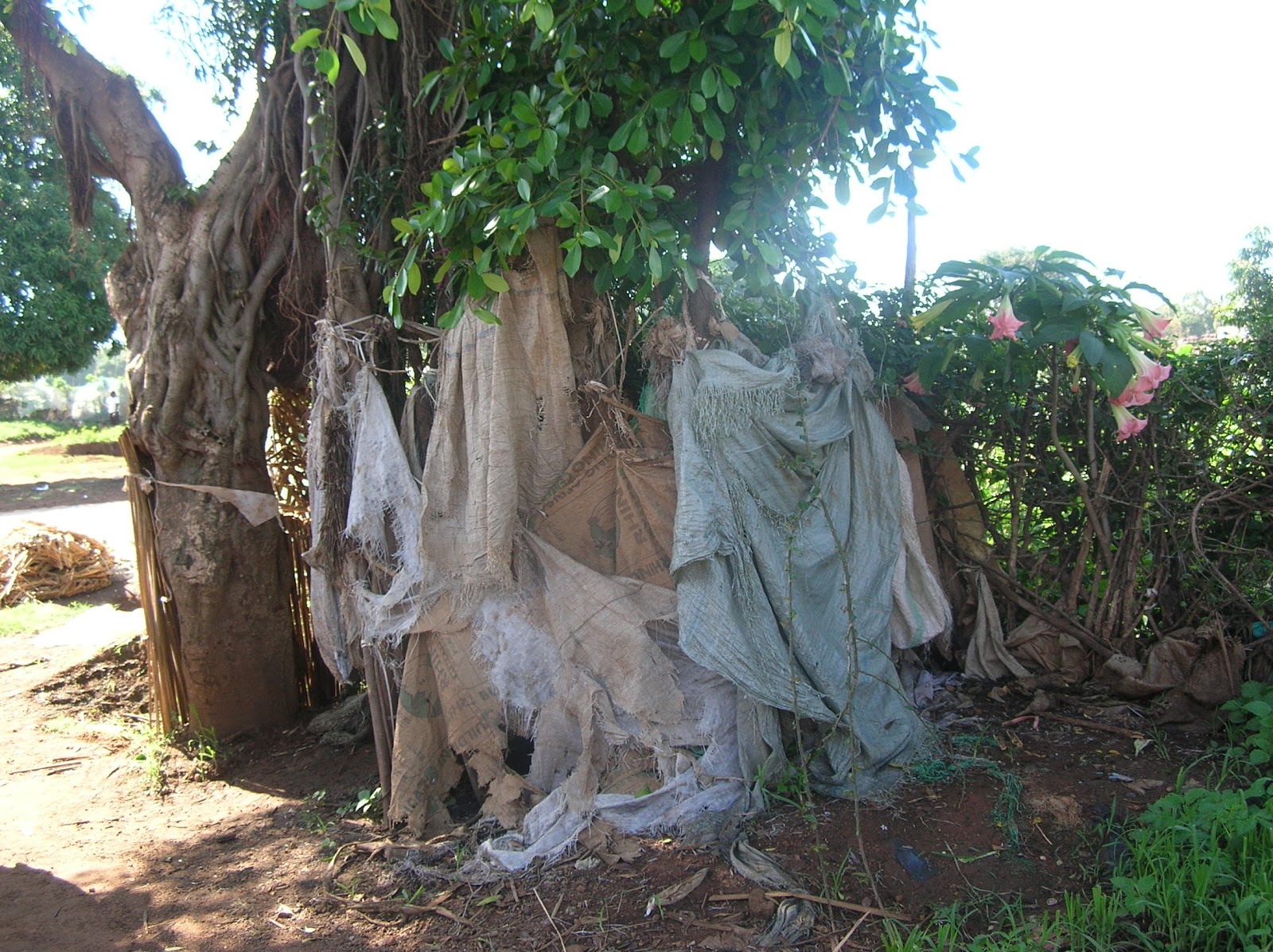
Human waste found in corridors,this was during 'flag the poo' game in the village. the exercise helped to create awareness and community members have started using toilets as a result of the activity
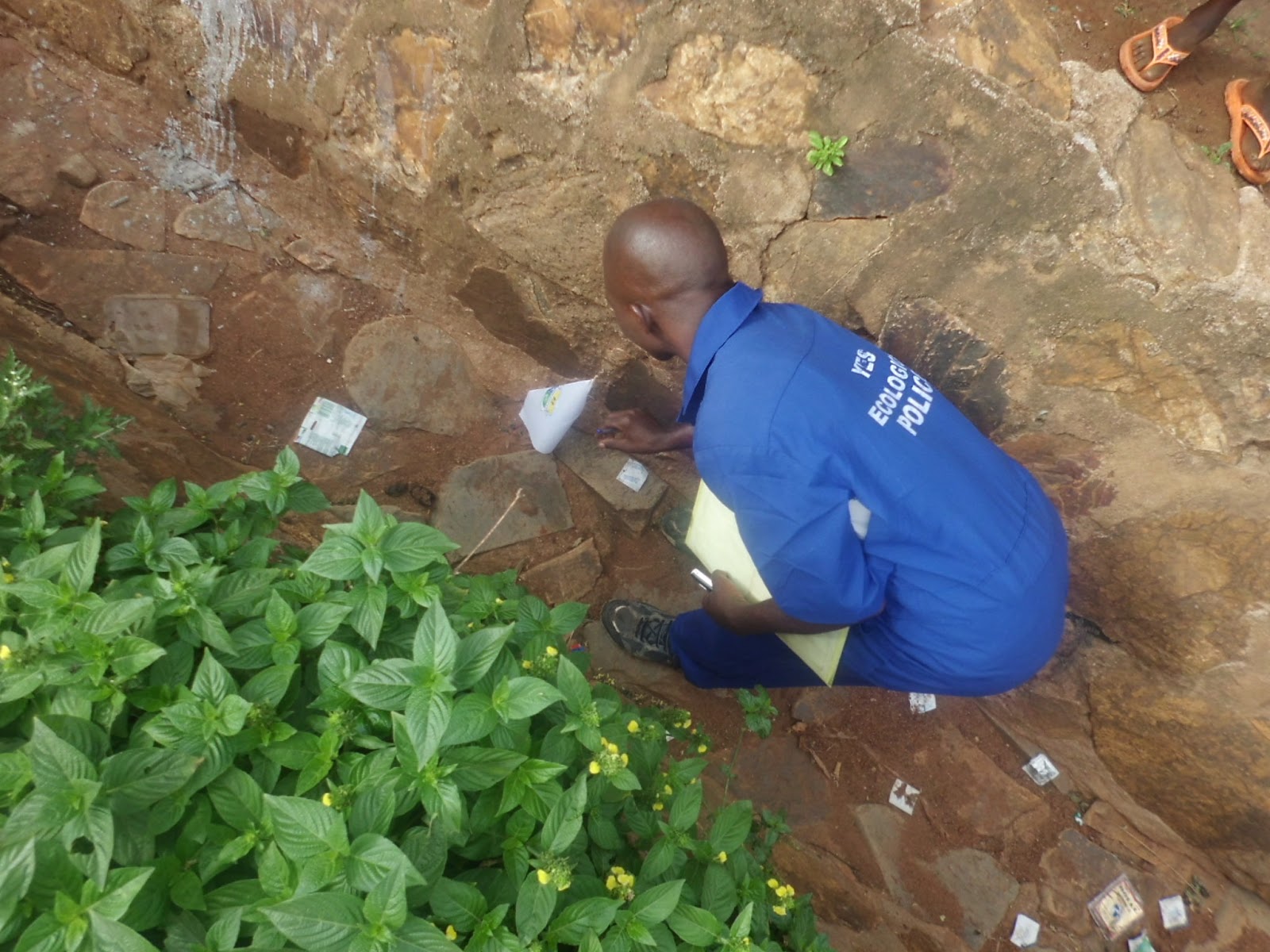 Mr. Ssebowa a Sanitation Improvement Committee member of Solo A village was among the team who flagged the poo
  No water for you unless you clean your water container.During the Sanitation Week,women were mobilized to clean their water containers.
Let me clean it, I cant afford going without the water, what if my husband asks me. The lady cleaning jerrycan seems to be lamenting


At least this one is smaller. She seemed to be murmuring.


More snap-shot for the clean up exercise at Omudiki spring well during thee sanitation week


Sanitation Improvement Committee members with their Jericans walking for water during World Water day celebration.

A young boy caught in action-openly defecating during the 'flag the poo' activity.

Members of Solo A village after cleaning their spring well


Monday, 15 April 2013
Monday, 8 April 2013
Wednesday, 3 April 2013
WASH United Hand washing with soap campaign in Busia
Youth Environment Service has an on-going program of promoting hand washing in schools within the Municipal Council. The program is being supported by Bill and Melinda Gates through Uganda Water and Sanitation Network-(UWAS-NET). In partnership with the school administrations, over 12 schools have been reached, including Arubaine Moslems', Victory, Winn and Joan, Busia Border, Parents' Pride, Mawero East, Marachi, Busia Basic, Busia Intergrated, Madibira, Fairway, Nagulu Islamic, Busia Frontier, Greens primary schools. The project staff and volunteers were able to raech about 200 school children per school. The campaign involved activities such as, Scoring into the World Toilet cup ('Kicking the poo in the loo'), Hand washing challenge, Tippe tap construction competitions. The major aim of these activities is to sensitize children on the need to wash their hands with soap after visiting the latrine and before eating food including the proper procedure, secondly, to promote proper use of a latrine to reduce on open defecation which is on increase.


Thursday, 14 March 2013
Launch of Waste Management Project
The Chief Guest will be the RDC of Busia and Venue will be Busia Municipal Gardens(Mayor's garden).


sanitation week
Youth Environment Service in partnership with the stakeholders and the general community is organising to observe the National Sanitation Week beginning from 18th to 21st March and end with celebration of the World Water Day on 22nd of March 2013.
The activities intended include;
Community mobilization, cleaning water sources. girls' WASH football competitions, tee pee tap construction competitions, World Toilet Cup game in villages, debates in schools, 'flag the poo' game, Sanitation songs and walking for water. The venue for the celebration will be at Mayor's Garden.
The activities intended include;
Community mobilization, cleaning water sources. girls' WASH football competitions, tee pee tap construction competitions, World Toilet Cup game in villages, debates in schools, 'flag the poo' game, Sanitation songs and walking for water. The venue for the celebration will be at Mayor's Garden.
Thursday, 27 September 2012
Recycling of Charcoal Briquettes from waste materials
Youth environment Service is implementing a project on waste
sanitation and management in Busia Municipality, Busia District. In tandem with reduction of waste load that
comes from the main market commonly known for ‘produce’, households, and from
the waste link agents, the organization saw it imperative to recycle some of
the waste instead of it being dumped in corridors which had made the situation
precarious. Secondly, the project will create employment to the young people,
increase on house hold income hence reduction on poverty, and enable self
sustainability by the Village Environment Committees (VEC). The whole process
started with a vigorous training which involved the Village Environment
Committees (VEC) and some of the organization field staffs who will go ahead
and train the rest of the members.
Make sure you tighten well this bolt. The
facilitator Silvia Naigaga from ARTI seems to be instructing the
trainees
Let us also try out on our own. The trainees
seem to be mentioning as they assemble the machine equipment.
Trainees assembling the briquette making machine
The waste of maize
cobs, dry leaves, waste papers, charcoal dust, banana peelings and dry grass is
expected to tremendously reduce in the town in the shortest time to come. A
serious hunt for them will proceed as more and more briquettes will be
produced.
Waste sorting going on
Filling the Kiln with the waste raw material
Waste combustion
The charcoal briquettes products will reduce on cutting down
of trees since charcoal briquettes will be on market hence environment
conservation. It will also be used for cooking and heating by many communities
in the informal settlement to boil their drinking water.
The process will also motivate food production since there
will be need for more raw materials.


Monday, 28 May 2012
Busia Uganda-Impact of ecological police of the village environment committee (VEC) shows improvement in promoting the role of communities in waste and sanitation management:
The town of Busia in Eastern Uganda faces many challenges, including of a rapid shift in its solid waste management systems; new technologies (composting, and landfilling) will be introduced in late 2012, while actual waste collection is still struggling to provide a hygienic environment to its inhabitant.
The goal of YES in waste management is the protection of human health and environment, where resource conservation) can be reached.
Community voices, sustainable development and policy reforms in implementing MDG7, target 9 the need for increased commitment in policy enforcement and improved good governance in waste and sanitation management.While leaders who discussed MDGs have articulated what to be done, the questions remains unanswered in cross border towns sharing common trans-boundary problems, where many people are still learning how to achieve this goal without policy harmonisation. YES is not waiting for the direction but to develop strategies to contribute towards the MDG related goals.
In its project of urban waste and sanitation project we are trying to help support 10 villages improve waste and sanitation management through community participation and strengthening systems by providing community basic services regarding mobilization, education and promoting community autonomy to manage waste and sanitation issues affecting them at household level.

 The approach will improve the community institutional arrangements for waste management; mobilize communities to construct toilets in residences and in schools, and increase efficient solid collection by Busia Municipal council.
The service volunteers of YES register all homes without toilets, and later provide sanitation, hygiene education and counseling to households and landlords to help them make informed decisions and interest to have better sanitary facilities using the WASH chain cards.(Above)
The plight of toilets:
In Marachi “A”B”C”D” Villages in Busia Municipality, it’s one of the villages YES organisation is promoting the role of communities in waste and sanitation management.


Many households don’t have toilets and our research found that women use the toilet facilities mainly at night when the privacy is guaranteed especially homes with this kind of structures.

 The project results will improve the quality of water in the municipality both surface and underground water by reducing huge waste flow in the water streams.
Rapid population growth, urbanization, and growing challenges of poverty faced by the urban poor in informal settlements and cross border towns require redefining the paradigm for public health interventions by creating new approaches that put urban environment determinants of health into consideration, with the goal of meeting the health needs of the community in Busia municipal council, the cross- border communities in the border town needs massive efforts towards promoting behavior change attitudes and practice where communities and the municipal council can work together and recognize that there are problems of increasing evidence of poor waste, sanitation and hygiene in the first place,(ii) and work towards community understanding the challenge as either manageable or not; both at individual household level, community level and local government institutional level;(iii) above all ,the involvement of stakeholders to recognize the challenges in a cooperative way is a prerequisite.(iv) the comunity can identify workable solutions and options to address the challenges both as an institution under local government and as individuals and communities for the case of urban town like Busia.
Below community members debating on during meeting at border primary school organized by YES, the town Clerk, Mayor and other stakeholders attended.
The community and other stakeholders can agree, develop and design plans for project implementation, when they both recognize the challenge within the community they reside and start implementing the plan regarding water management and environmental health in the neighborhood.


The positive actions the community and other stakeholders have implemented can be maintained by both at cooperative level for the success of the issues identified such as poor storage, disposal, transportation, collection and general awareness’s and debate on waste management,sanitation and hygiene.
The community can also agree to sustain the decision for long term impact and environmental sustainability and for the good of the community.

The village environment committee members observe how the woman was getting dirty water from the only stream in Nagunke in Mawero East A village.


The Youth environment service volunteers conduct WASH dissemination education and group counseeling in Marachi villages,YES achievements and efforts in the comunity has been succesfully through building the capacity of its volunteers in comunity mobilisation and education dynamics.
Subscribe to:
Posts (Atom)